Music Catalog Solutions

Solve catalog gaps before they block delivery, licensing, or review.

Outcome-based workflows help creators and music teams inspect metadata quality, rights readiness, catalog integrity, and delivery requirements, then act on what needs attention.

Organize

Catalog intelligence for operational music catalog decisions.

Understand

Catalog intelligence for operational music catalog decisions.

Review

Catalog intelligence for operational music catalog decisions.

Export

Catalog intelligence for operational music catalog decisions.

By audience

Practical outcomes for every music team

Independent Artists

Organize releases, metadata, and rights in one reviewable catalog.

Composers and Producers

Connect works, recordings, credits, and ownership information.

Labels

Validate multi-artist catalogs before downstream delivery.

Publishers and Rights Teams

Govern writers, publishers, shares, and clearance information.

Production Music Libraries

Prepare discovery data, cue sheets, and delivery packages.

Enterprise Music Organizations

Standardize catalog review and preparation at scale.

Use Cases

Clear workflows for catalog readiness, quality control, and delivery.

Connected music asset network showing audio, files, contributors, rights, storage, and search.

Music Asset Governance

Govern music assets, metadata, rights information, cue sheets, and archival records across teams, catalogs, and systems.

  • Metadata integrity
  • Rights completeness
  • Catalog auditability
  • Search-ready archives
Learn More
Packaged music file connected to cloud, audiences, and global delivery destinations.

Distribution Readiness

Prepare release and track metadata for cleaner handoff across delivery partners and internal teams.

  • Catch missing identifiers
  • Standardize core fields
  • Reduce export cleanup
Learn More
Magnifying glass reviewing a music note against an audio waveform.

Sync Licensing Readiness

Improve the metadata, rights, keywords, and audio context buyers need before reviewing music.

  • Strengthen pitch metadata
  • Surface clearance risks
  • Package buyer-ready exports
Learn More
Structured metadata table being refined with a glowing wand and quality signals.

Metadata Cleanup

Audit inconsistent credits, descriptions, moods, genres, ownership fields, and delivery signals.

  • Identify quality gaps
  • Prioritize cleanup work
  • Improve searchability
Learn More
Rights network connecting contributors, documents, publishers, and financial records.

Rights Records Review

Review ownership, splits, publishers, PRO data, and contributor details before commercial use.

  • Find possible conflicts
  • Review contributor data
  • Support clearance preparation
Learn More
Production music library system connecting cue sheets, audio, artwork, and folders.

Production Music Library Management

Organize master audio, artwork, lyrics, cue sheets, contracts, and supporting files.

  • Organize cue metadata
  • Improve discovery signals
  • Streamline delivery
Learn More
View All Workflows

Catalog Due Diligence

Assess catalog health, metadata completeness, rights risk, and export readiness for review.

Score catalog qualityDocument risk areasSupport acquisition review
Learn More

Platform Migration

Move catalog records from spreadsheets, legacy systems, or platform exports into a governed workspace.

Normalize imported dataMap catalog structuresPreserve migration context
Learn More

Publisher Registration Readiness

Prepare works, contributors, splits, identifiers, and publisher details for registration workflows.

Review required fieldsValidate ownership detailsCreate audit-ready records
Learn More

Governed catalog operations

Music Asset Governance

The operational problem

Music assets, metadata, rights information, cue sheets, and supporting records often live across disconnected folders, spreadsheets, email threads, and separate systems.

How CatalogIQOS supports the workflow

Bring catalog records into one governed workspace where teams can review metadata integrity, ownership coverage, asset status, catalog history, and readiness signals.

Relevant capabilities

  • Catalog and track records
  • Audio asset management
  • Rights and ownership records
  • Cue-sheet review
  • Activity and audit history
  • Global Search

Expected outcome

A more complete, searchable, and auditable catalog workspace.

Explore Catalog Management
Connected music asset network showing audio, files, contributors, rights, storage, and search.

Example workflow

  1. 1Import catalog metadata.
  2. 2Associate master audio and supporting records.
  3. 3Review missing or conflicting information.
  4. 4Confirm ownership and publishing relationships.
  5. 5Track changes and prepare governed exports.

Structured delivery preparation

Distribution Readiness

The operational problem

Incomplete identifiers, inconsistent version labels, missing core fields, and mismatched catalog structures create cleanup work before release delivery.

How CatalogIQOS supports the workflow

Validate release and track metadata, identify missing required fields, standardize records, and prepare structured export packages for downstream handoff.

Relevant capabilities

  • Spreadsheet Import
  • Column mapping
  • Validation rules
  • Metadata editing
  • Catalog Audit
  • Export packages

Expected outcome

Cleaner release metadata and fewer downstream corrections.

See the Import Workflow
Packaged music file connected to cloud, audiences, and global delivery destinations.

Example workflow

  1. 1Upload CSV or XLSX metadata.
  2. 2Review detected mappings.
  3. 3Resolve blocking conflicts.
  4. 4Standardize titles, identifiers, and versions.
  5. 5Generate the required export package.

Buyer-ready discovery

Sync Licensing Readiness

The operational problem

Music buyers need searchable metadata, clear ownership, useful descriptive context, available audio, and licensing readiness before they can confidently review a track.

How CatalogIQOS supports the workflow

Improve descriptive metadata, review rights and clearance signals, surface missing information, and prepare buyer-oriented catalog exports and pitch materials.

Relevant capabilities

  • AI Optimization
  • Audio Intelligence
  • Rights readiness
  • Global Search
  • Pitch builder
  • Sync readiness reports

Expected outcome

A catalog that is easier to search, evaluate, and pitch for licensing.

Explore Sync Readiness
Magnifying glass reviewing a music note against an audio waveform.

Example workflow

  1. 1Analyze available audio.
  2. 2Review genre, mood, instrumentation, and usage suggestions.
  3. 3Confirm writers, publishers, and master control.
  4. 4Resolve clearance warnings.
  5. 5Package selected tracks for review.

Controlled metadata quality

Metadata Cleanup

The operational problem

Catalog records often contain inconsistent credits, naming, genres, moods, descriptions, identifiers, and ownership fields.

How CatalogIQOS supports the workflow

Audit the catalog, prioritize quality gaps, review AI-assisted improvements, and update canonical metadata through a controlled review process.

Relevant capabilities

  • Catalog Audit
  • AI Optimization
  • Metadata Health
  • Action Center
  • Bulk suggestion review
  • Change history

Expected outcome

More consistent metadata and stronger catalog discoverability.

See AI Optimization
Structured metadata table being refined with a glowing wand and quality signals.

Example workflow

  1. 1Run a catalog audit.
  2. 2Review prioritized findings.
  3. 3Run AI Optimization.
  4. 4Accept or reject suggestions.
  5. 5Re-audit and export the cleaned catalog.

Administrative rights clarity

Rights Records Review

The operational problem

Ownership splits, contributor identities, publisher assignments, PRO data, master control, and clearance status can be incomplete or contradictory.

How CatalogIQOS supports the workflow

Review composition ownership, publishing administration, contributor records, master ownership, territories, and licensing status in one structured workflow.

Relevant capabilities

  • Contributor directory
  • Publisher directory
  • Writer splits
  • Publisher assignments
  • Master ownership
  • Rights Validation

Expected outcome

A clearer administrative rights record that supports licensing review.

Explore Rights Governance
Rights network connecting contributors, documents, publishers, and financial records.

Example workflow

  1. 1Confirm all writers and ownership shares.
  2. 2Review contributor PRO and IPI data.
  3. 3Assign publishers to each writer’s interest.
  4. 4Confirm master ownership and territory.
  5. 5Review clearance and validation findings.

Catalog-centric library operations

Production Music Library Management

The operational problem

Production libraries manage audio, metadata, alternate versions, artwork, cue sheets, contracts, rights records, and delivery files across many catalogs and projects.

How CatalogIQOS supports the workflow

Organize these records in a catalog-centric workspace with ingestion, search, metadata review, rights governance, cue-sheet intelligence, and structured delivery workflows.

Relevant capabilities

  • Multi-catalog workspace
  • Audio asset management
  • Version and alternate tracking
  • Cue Sheet Import & Review
  • Contract Intelligence
  • Search and exports

Expected outcome

A more controlled operating workspace for production music teams.

Explore the Enterprise Demo
Production music library system connecting cue sheets, audio, artwork, and folders.

Example workflow

  1. 1Import the catalog and version families.
  2. 2Upload or associate master audio.
  3. 3Review metadata and rights completeness.
  4. 4Process cue sheets and supporting records.
  5. 5Search, pitch, and deliver catalog packages.

Additional workflows

More ways to review and prepare a music catalog

Documented catalog evaluation

Catalog Due Diligence

The operational problem

Catalog acquisitions, partnerships, migrations, and administration changes require teams to understand metadata quality, rights completeness, ownership risk, identifier coverage, and delivery readiness before making decisions.

How CatalogIQOS supports the workflow

CatalogIQOS brings catalog records into a controlled review environment where teams can audit metadata, identify rights gaps, review contributors and publishers, examine duplicate risk, and generate structured findings for internal evaluation.

Relevant capabilities

  • Catalog Audit
  • CatalogIQ scoring
  • Metadata Health
  • Rights Validation
  • Contributor and publisher review
  • Duplicate-risk signals
  • Export readiness
  • Executive PDF reports

Expected outcome

A clearer, documented view of catalog quality, administrative gaps, and readiness risks before acquisition, migration, or partnership decisions.

CatalogIQOS supports administrative review and documentation. It does not replace legal, accounting, valuation, or title-opinion services.

Explore the Compare Page
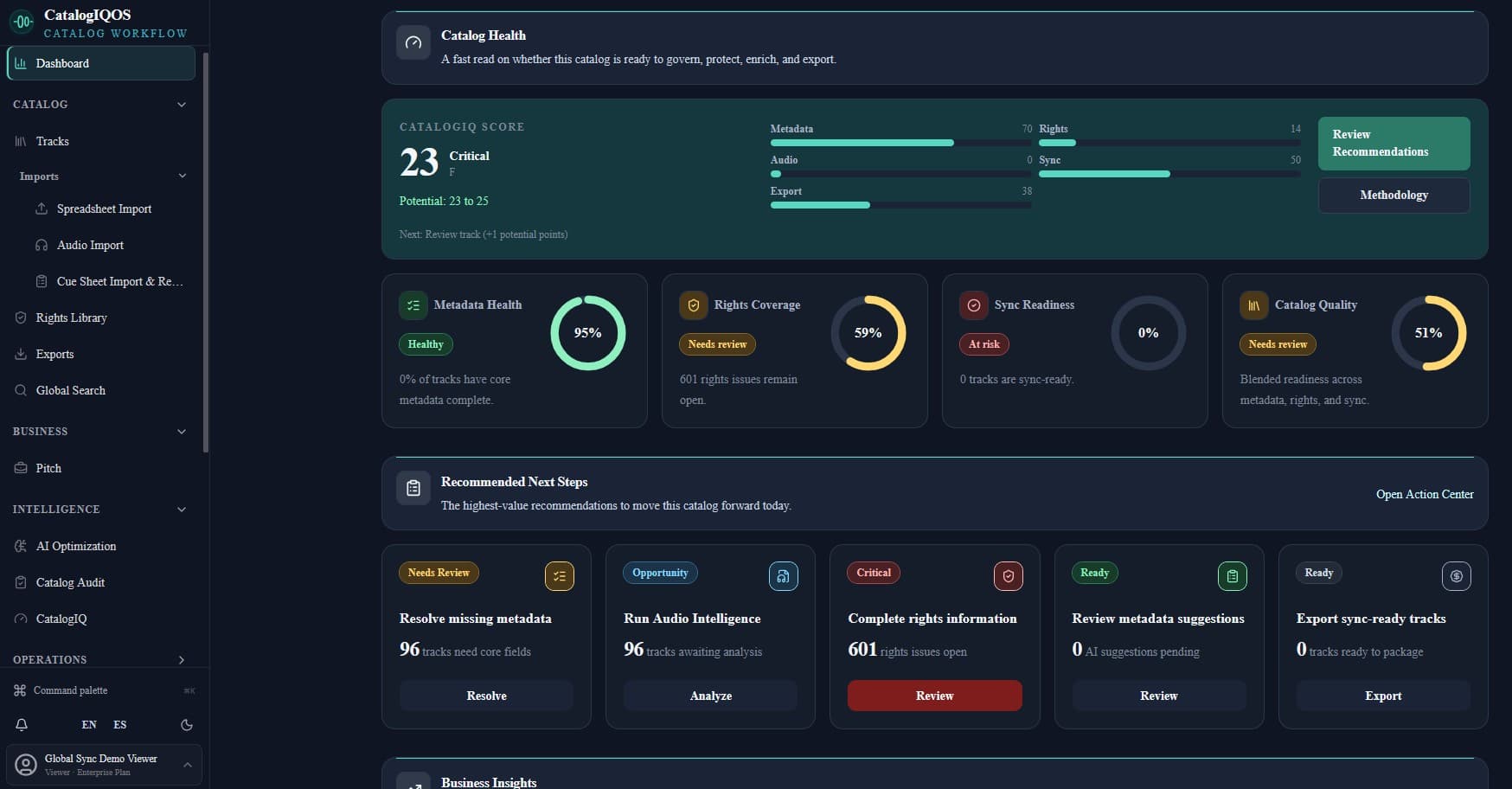
CatalogIQOS Command Center showing catalog health, priorities, and readiness signals.

Example workflow

  1. 1Import the catalog under review.
  2. 2Validate mappings, identifiers, and required fields.
  3. 3Run Catalog Audit and CatalogIQ scoring.
  4. 4Review contributor, publisher, split, and master-control gaps.
  5. 5Prioritize high-risk findings.
  6. 6Export a structured findings package for internal review.

Controlled catalog transition

Platform Migration

The operational problem

Catalog data moved from spreadsheets, legacy databases, distributors, libraries, or prior software often contains inconsistent headers, naming conventions, duplicate records, incomplete identifiers, and platform-specific fields.

How CatalogIQOS supports the workflow

CatalogIQOS helps teams map source columns, validate incoming records, preserve source context, resolve conflicts, and prepare normalized catalog data for a controlled destination workflow.

Relevant capabilities

  • CSV and XLSX import
  • Column mapping
  • Saved mapping profiles
  • Match and reconciliation logic
  • Validation reports
  • Create and update modes
  • Import history
  • Structured exports

Expected outcome

A more controlled migration process with clearer provenance, fewer duplicate records, and less manual cleanup.

Migration support depends on available connectors and supported file formats; source systems are not connected automatically.

See How Import Works
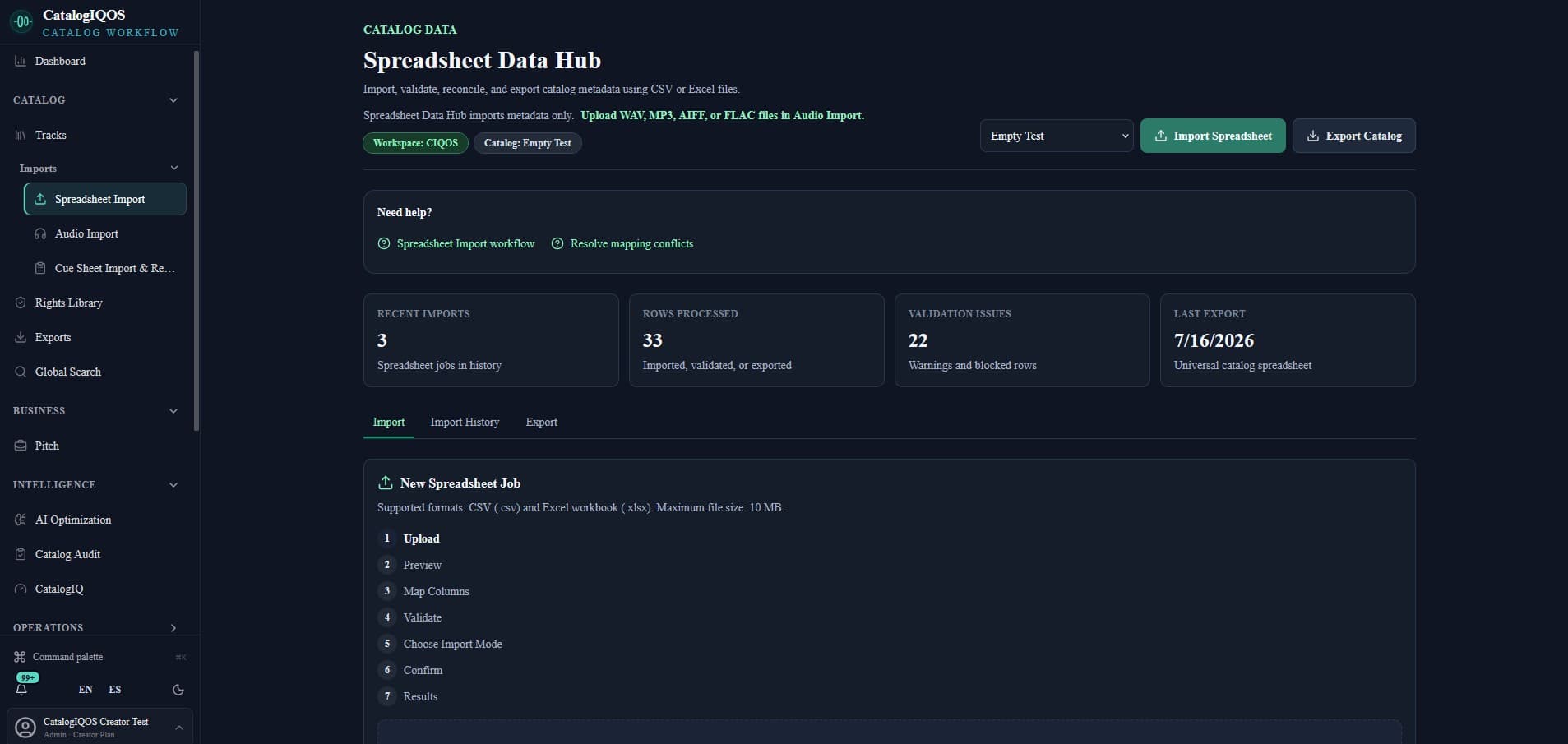
CatalogIQOS spreadsheet import screen showing source-column mapping and validation.

Example workflow

  1. 1Upload the source spreadsheet or supported export.
  2. 2Select the correct worksheet.
  3. 3Review detected column mappings.
  4. 4Resolve duplicate mappings and validation conflicts.
  5. 5Choose create, update, or reconciliation mode.
  6. 6Confirm the import.
  7. 7Review imported records and export normalized catalog data.

Registration data preparation

Publisher Registration Readiness

The operational problem

Works may be delayed or rejected during registration when writer identities, PRO affiliations, IPI/CAE numbers, ownership splits, publisher assignments, territories, or identifiers are incomplete or inconsistent.

How CatalogIQOS supports the workflow

CatalogIQOS helps teams review contributor records, ownership totals, publisher administration assignments, work identifiers, territories, and verification status before preparing registration information.

Relevant capabilities

  • Contributor directory
  • PRO and IPI/CAE fields
  • Writer ownership splits
  • Publisher directory
  • Writer-specific publisher assignments
  • ISWC and ISRC review
  • Territory and agreement data
  • Rights Validation

Expected outcome

A more complete and internally consistent registration-preparation record.

CatalogIQOS prepares and validates administrative data. It does not submit registrations to a PRO or guarantee registration acceptance unless a supported integration is explicitly available.

Explore Rights Readiness
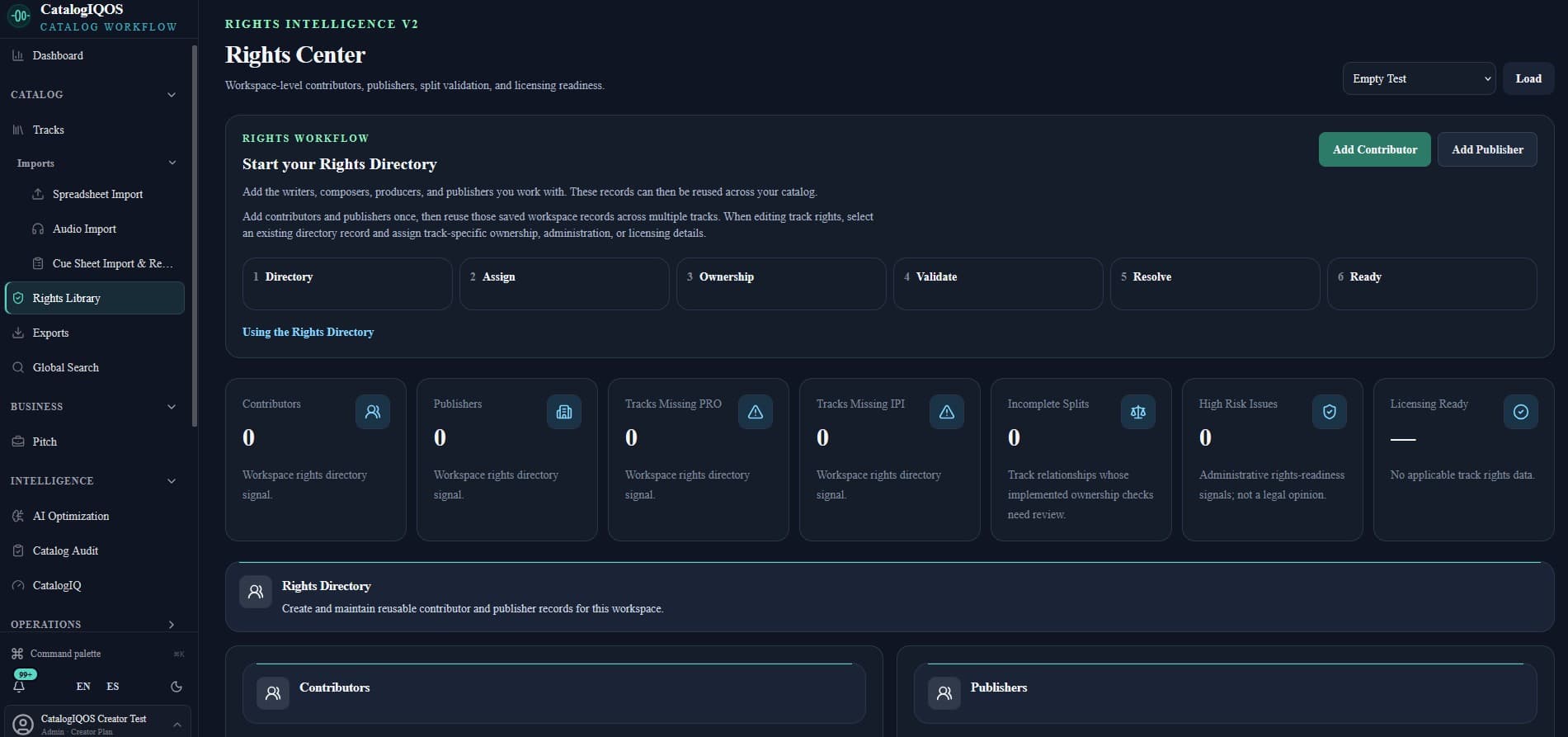
CatalogIQOS Rights Center showing ownership, contributor, and clearance review signals.

Example workflow

  1. 1Confirm all writers and creative roles.
  2. 2Review PRO affiliations and IPI/CAE numbers.
  3. 3Confirm composition ownership totals 100%.
  4. 4Assign the publisher or administrator for each writer’s interest.
  5. 5Review work identifiers and territories.
  6. 6Resolve Rights Validation findings.
  7. 7Export the reviewed registration data.

Start with a catalog your team can understand and improve.

CatalogIQOS identifies possible gaps and generates AI-assisted candidates. Your team reviews important changes before they become catalog data.

Music Catalog Solutions | CatalogIQOS